Why Freshers is a 'must have' media buy for brands
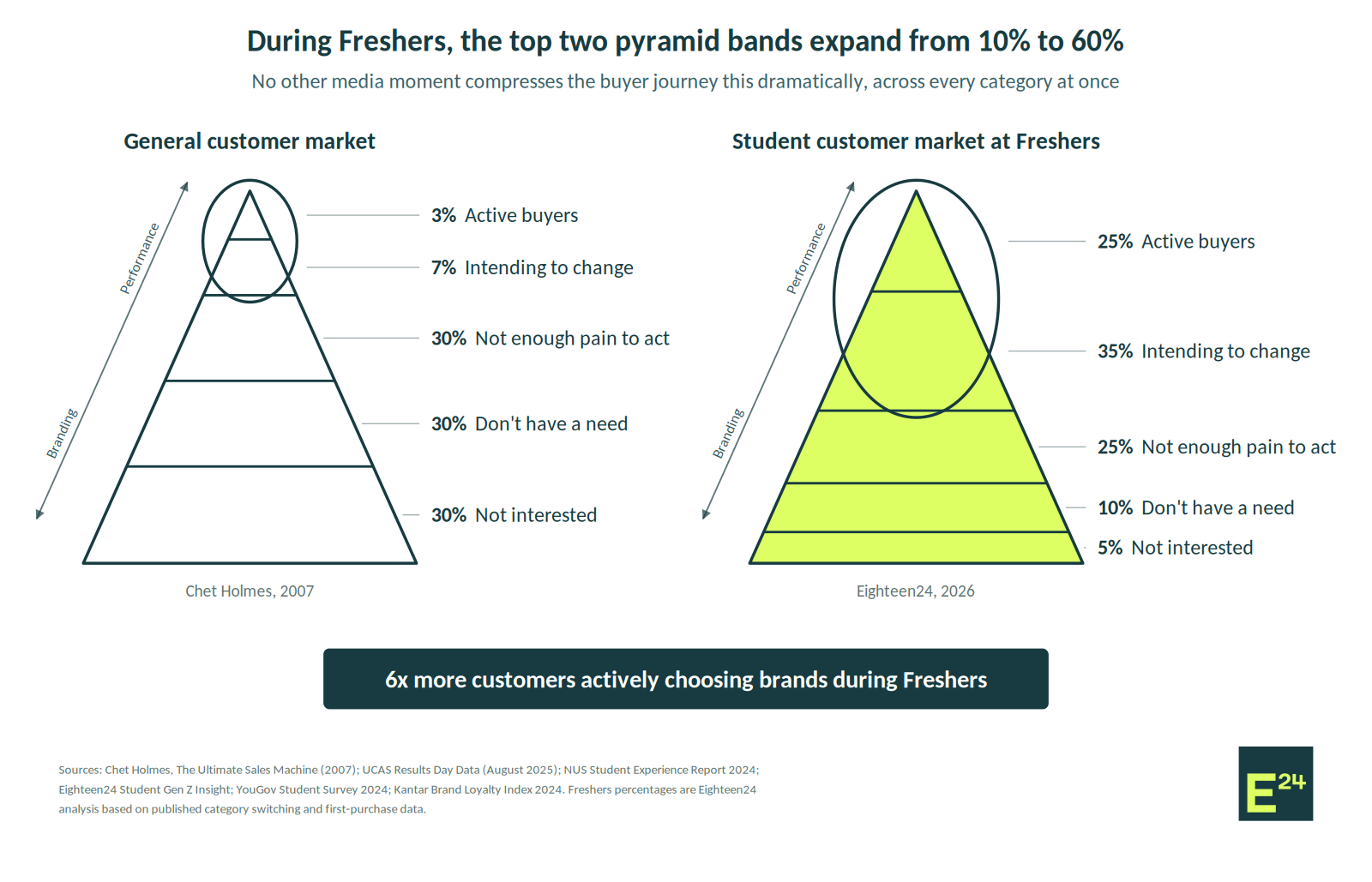
Chet Holmes' market pyramid says only 3% of customers are ready to buy and 7% are open to it. That holds for a general consumer market. Put students at Freshers in the same pyramid and those two bands expand to 60%- six times as many people actively choosing, most of them for the first time.
Sarah O’Sullivan
Chief Revenue Officer
I've spent 20+ years looking at a pyramid that works for a mass consumer market, but not for students.
Working in sales and revenue for most of my career means I've spent more than two decades referencing Chet Holmes' famous market pyramid to boardrooms, brand teams, media planners and buyers. You probably know it. The one that says only 3% of your potential customers are actively ready to buy at any given moment. The one that says 30% don't even know they have a need yet.
It's one of those frameworks that becomes furniture. You stop seeing it. You just accept it as a law of consumer behaviour, like gravity.
Since working at Eighteen24, however, I've been reconsidering this status quo in the context of students at Freshers, and as such, I've had to redraw the whole thing, because, put simply, the same rules don't apply to students.
A market that resets itself every September.
Last autumn, 577,725 undergraduates began their university careers. The 2025 intake was up 4.7% on 2024, a record high according to UCAS. Each September, every year, 500,000+ students move to new cities. They open new bank accounts. They stock new kitchens. They subscribe to new streaming services, buy new clothes, choose new gyms, discover new brands.
So what makes this cohort genuinely different from any other consumer segment? It's the fact they do all of this simultaneously, within the same six-week window, with no incumbent brands in the way. There is no loyalty to overcome. No switching cost to absorb. No existing relationship to disrupt. Every category, across banking, food, fashion, telecoms, entertainment, travel and beyond, resets to zero at the same moment, for a new Freshers cohort, year after year. The market literally renews itself. I know of no other audience in consumer marketing that does this. Not one.
What the neuroscience actually tells us.
This isn't just a commercial opportunity. There's a biological case for it too.
The adolescent brain (and at 18, students are still in late adolescence) is hardwired for novelty-seeking and experimentation. The prefrontal cortex, which governs long-term decision-making and habitual behaviour, doesn't fully mature until around 25. In the meantime, the brain's reward circuitry is highly responsive to new experiences, new social environments and new identity formation.
What does that mean for brands? It means that the 18-year-old student arriving at university for the first time is neurologically primed to try new things in a way they never will be again. They are not just open to new brands. Their brains are actively seeking them.
This is the golden window. And most brands are sleeping through it.
The pyramid redrawn.
The Holmes model describes a general adult population. Adults with existing bank accounts, existing grocery habits, existing brand loyalties. The pyramid works for them. The 3% active, 7% considering. That's what consumer inertia looks like.
But students at Freshers are not a general adult population. They are a population in simultaneous transition across every purchasing category.
So, I rebuilt the pyramid for them. In the Freshers model, the top two bands - the people actually making purchasing decisions right now or actively open to making one soon - expand from 10% to 60% within a student population. Six times the opportunity to be the brand that gets chosen first.
In Freshers Week alone, the average student spends £421 - and that figure has grown consistently year on year, rising from £368 in 2019 to £406 in 2020 to £421 in 2021. Accounting for inflation since then, that number is likely well north of £450 today. Monthly student spend across the academic year averages £1,142, with clothing, shoes and accessories alone accounting for £123 a month after rent and groceries. This is not a niche. There are almost three million students in UK higher education, and at the sharpest end, over half a million brand-new ones arriving every September with fresh budgets, fresh needs and no pre-existing preferences.
First-mover advantage with a renewable lease.
What gets underestimated most in brand planning conversations is the compounding value of acquiring a student customer during Freshers.
Gen Z are five times more likely than older generations to believe that newer brands are better, according to McKinsey, but once loyalty is established, it holds. Win the student in September and you don't just win them for three years of university. You win the graduate, the young professional, the future high earner. Only 6% of Gen Z are currently planning to buy property; they are still in the accumulation phase of their consumer lives, building habits and relationships with brands that will follow them for decades.
And unlike virtually every other consumer segment, the market renews. A new cohort of 500,000+ first-years arrives in September 2026. And they will again in 2027. And every year after that. The brands that show up consistently at Freshers are not simply acquiring new customers. They are building an annual acquisition engine.
What this means for brand investment.
I've sat in too many planning meetings where the student market gets treated as a nice-to-have rather than a must-have.
That's entirely the wrong framing.
Half of all Gen Z consumers regularly try new brands, and they are particularly susceptible to brand switching, but the loyalty that follows genuine early engagement is powerful and persistent. The brands that invest in being present, relevant and visible at the precise moment students are making their first independent choices are not simply running a campaign. They are making a long-term acquisition investment with a customer lifetime value that dwarfs the cost of reaching them.
The Chet Holmes pyramid doesn't lie for the majority of customers. It just needed redrawing for student customers, because their real value to brands is supercharged and undeniable.