Nine Terms: The Brand Map of a UK Degree
Three years. Nine terms. One very predictable customer.
Sarah O’Sullivan
Chief Revenue Officer
A UK degree is the most predictable life stage a brand will ever plan against. 2.86 million students start, restart and spend on one national calendar. Their money lands in the same three windows every year: September, January and April.
Yet most plans still treat "students" as one audience and Freshers as one moment. Turn up in September, hand out a tote bag, go home.
That misses most of the value. The 18-year-old who arrives in September is not the 21-year-old who graduates. Between them sit nine terms, two house moves, a first bank account, a first bill, a first job application and a first salary.
Their needs change in a set order, and every change opens a category. This paper maps that order. It rebuilds Maslow's hierarchy for the student years, then walks the degree term by term to show when each brand vertical earns its place on campus.
The principle is simple. Show up when the need is real, not just when the calendar says Freshers.
A generation building its future
The student story isn't only one of financial pressure, uncertainty and adjustment. It is also one of opportunity, discovery and growth.
The 2026 Student Academic Experience Survey from HEPI and Advance HE, which polled more than 10,000 full-time undergraduates, makes the point. 66% of students are happy with their choice of course and university and wouldn't change anything, up from 56% in 2025. 45% rate their course good or very good value for money, the highest in more than a decade.
Yes, the pressure is real. But alongside it sit new friendships, curiosity, confidence and the thrill of finding out what's possible. University isn't something students get through. For most, it's something they're choosing, enjoying and investing in.
That matters for marketers. Students shouldn't be defined by their vulnerabilities or their hunt for value. They are ambitious, curious, increasingly confident consumers. The opportunity isn't only to help them through the hard moments. It's to be part of the good ones.
The Student Hierarchy of Needs
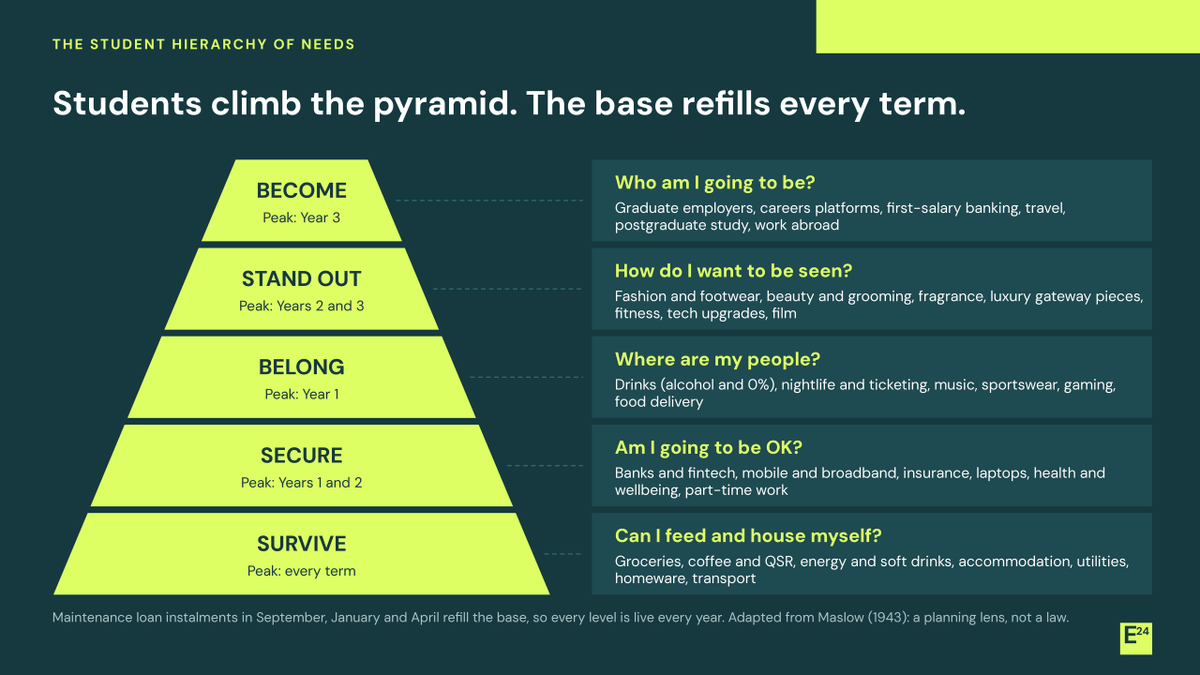
Maslow's pyramid, rebuilt for a degree, shows which brand categories a student is ready for and when. Students climb it across three years, but they never leave the lower levels behind.
Read it two ways. Upwards, it is the arc of the degree: Year 1 is about surviving and belonging. Year 3 is about becoming. Across, it is every single term, because each loan instalment refills the base and the weekly shop, the phone bill and the Friday social all come round again.
That second reading is what most plans miss. A graduate employer belongs at the top in Year 3. A supermarket, a bank or a drinks brand is relevant to every student, every term, for three years.
One honest caveat. Maslow's ordering is a planning lens, not a law of nature, and real students hold several levels at once. Use it to choose the message and the moment, not to rule a category in or out.
Year one: Arrival. Everything is a first.
Year one is the single biggest acquisition window in an adult's life. In 2024/25, 668,170 students began a first degree, and four in five students live away from the parental home while they study.
Nothing is a habit yet. The first bank account, the first weekly shop, the first phone contract, the first round at the union bar: each is a brand decision made from scratch, often in the same fortnight.
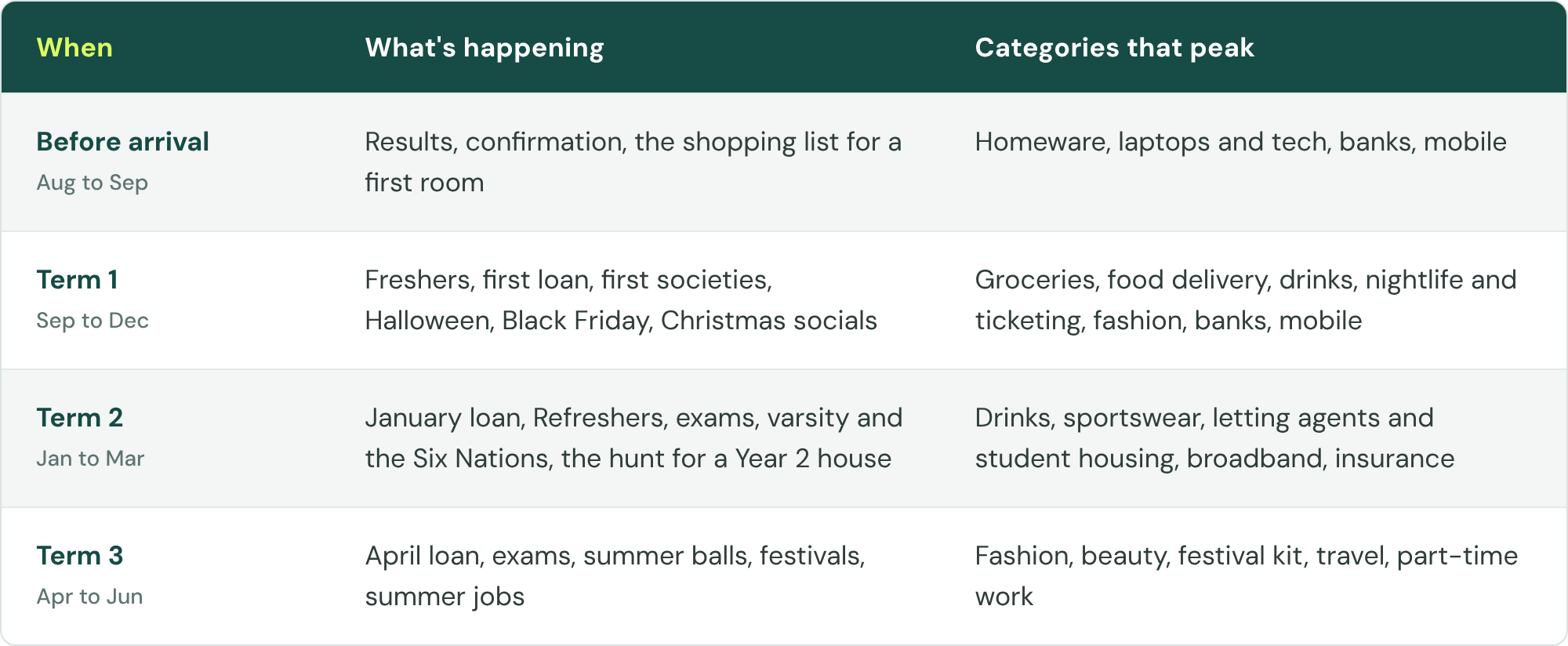
The openness is measurable. 78% of students say they are more open to new brands in September, and 70% try new brands at moments of transition. Term one alone is worth £2.2bn in student spend. And 65% of students stay loyal to brands they discover during Freshers.
Two moments are routinely missed. January is a second arrival, with a new loan instalment and Refreshers programmes such as Sussex's two-week Refreshers in late January. And the Year 2 house hunt starts in Year 1: some students sign as early as October, while others wait until the new year, so housing, broadband and insurance brands need to be visible from November.
What Year one asks of brands: be there first, be useful, be easy. This is where the base of the pyramid and the Belong level are bought, and the habits formed now are the hardest for a rival to dislodge.
Year two: Identity. From finding your place to defining it.
By the second year, the questions change. What am I into? What do I stand for? What makes me different? In Maslow's terms, this is esteem: confidence, competence, independence and recognition.
Year two is when a student stops living in a system and starts running one. Those who lived in halls in their first year now move into a shared house with a tenancy, a broadband contract, an energy account and a kitchen that nobody else cleans or stocks.
That move shifts weight up the pyramid. Survive and Secure categories don't disappear: they get bigger and more grown-up. Belong is settled. Stand Out takes over.
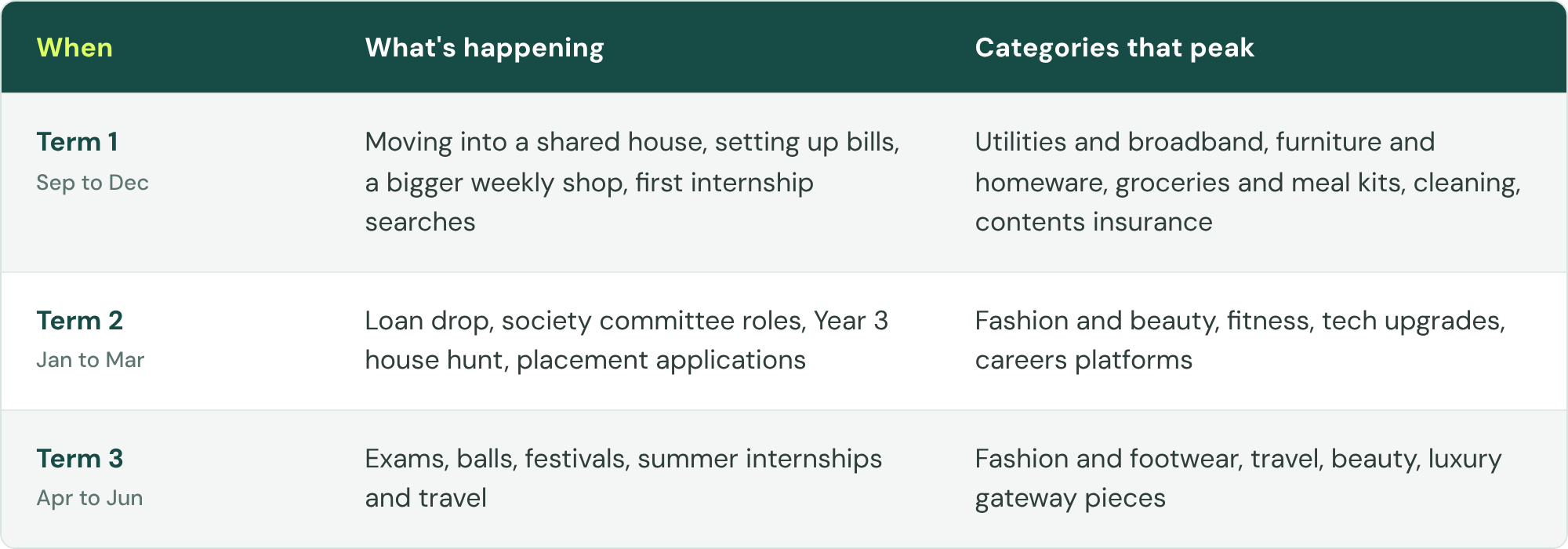
This is the identity year. Friendship groups have formed, the course has found its rhythm, and style becomes a statement. Students spend £123 a month on clothes, shoes and accessories, their third-biggest outgoing after rent and groceries. 73% of Gen Z now exercise at least twice a week, which is why gyms, activewear and athleisure peak here.
It is also the year careers quietly start. Employers advise students to begin researching graduate routes in their second year, and summer internships are the first real test of a CV. Work is already part of the week: 65% of full-time undergraduates worked during term time in 2026, averaging nearly 14 hours a week.
What Year two asks of brands: support something good that's already happening. Fitness brands can become part of a new routine. Tech brands can power creativity and productivity. Travel brands can open up new experiences. Employers can show students possibilities they hadn't considered. The brands that kept showing up get the upgrade.
Year three: Becoming. The launchpad.
Year three is the bridge from student to earner, and the top of the pyramid finally takes the lead. The questions change from "where are my people?" to "who am I going to be, and how do I get there?"
The calendar is unforgiving. Most graduate schemes recruit between September and December of the final year, and employers now receive an average of 140 applications per vacancy. A student applying in January has often missed the window.
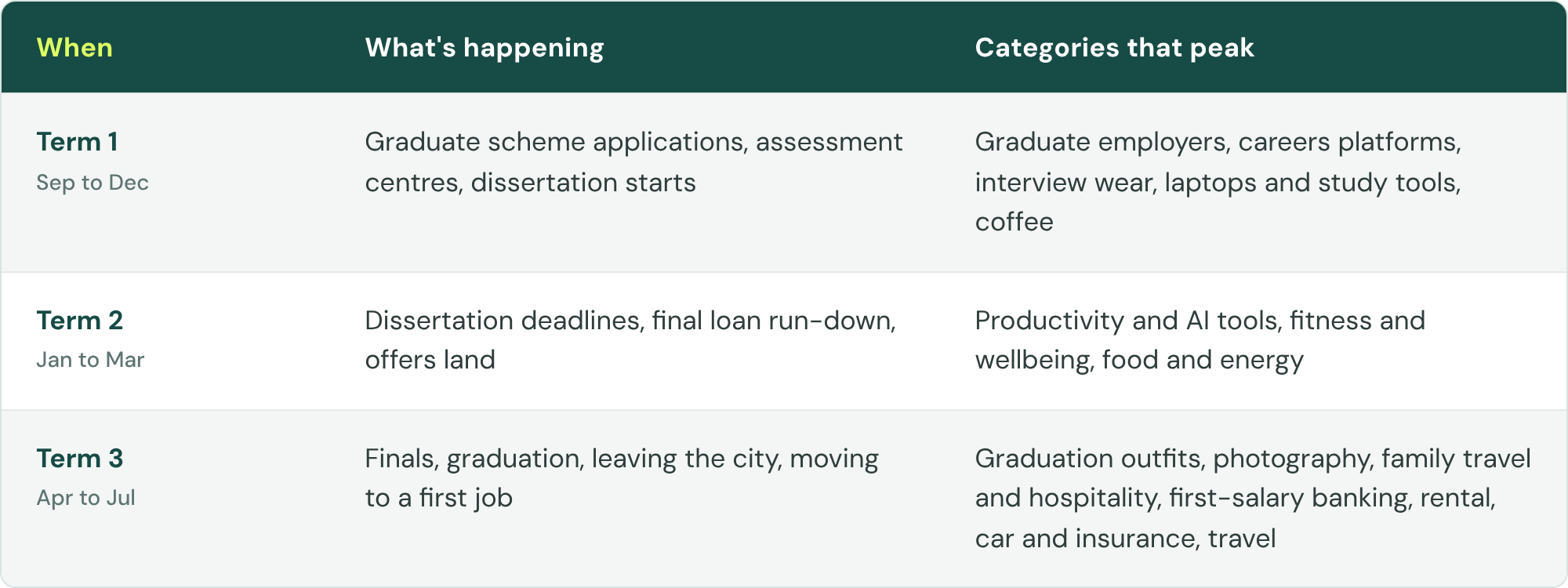
Graduation is a commercial moment in its own right. Outfits, photos, family dinners, hotel stays and leaving parties all land in a few weeks, then the student moves cities and makes a fresh round of first decisions: a graduate account, a first flat, a first car.
That is where the long game pays out. UK graduates earn around £100,000 to £130,000 more over a lifetime than comparable non-graduates, after tax and loan repayments, and their earnings grow 72% between the ages of 23 and 31. Five years on, 85% are still friends with people they met at university.
What Year three asks of brands: help them make the leap. The brand that helped land the job, dress for the interview or fund the first flat is the brand that follows them into a salary.
Six rules for planning against the degree
The map turns into a plan with six rules. None of them needs a bigger budget, only better timing.
- Plan for the cohort, not the moment. A degree is nine terms. A week in September meets the arrival. A presence across the year reaches the habit.
- Match the message to the level. Sell security to a fresher sorting a bank account, belonging to a fresher finding their people, status to a second-year curating a look, and a future to a finalist.
- Follow the loan clock. Maintenance loans land in September, January and April. Those three windows are the most predictable spending spikes of any audience of this size.
- Get in before the repertoire settles. In high-loyalty categories such as spirits, a brand holds 41 to 45% of its buyers' category spend, against 25 to 29% in grocery. For almost every brand, a first-year is still a non-buyer.
- Remember the pyramid resets every September. A new intake arrives every year, so the base is always being bought. Year 3 categories can recruit next year's finalists while they are still in Year 2.
- Be where every level meets. The Students' Union is the one building that serves all five levels: the shop and café at the base, the bar and societies in the middle, the careers fair at the top. Students visit several times a week, for 40 minutes or more at a time.
Brands don't need to be on campus for three years straight. They need to be there when the need is.
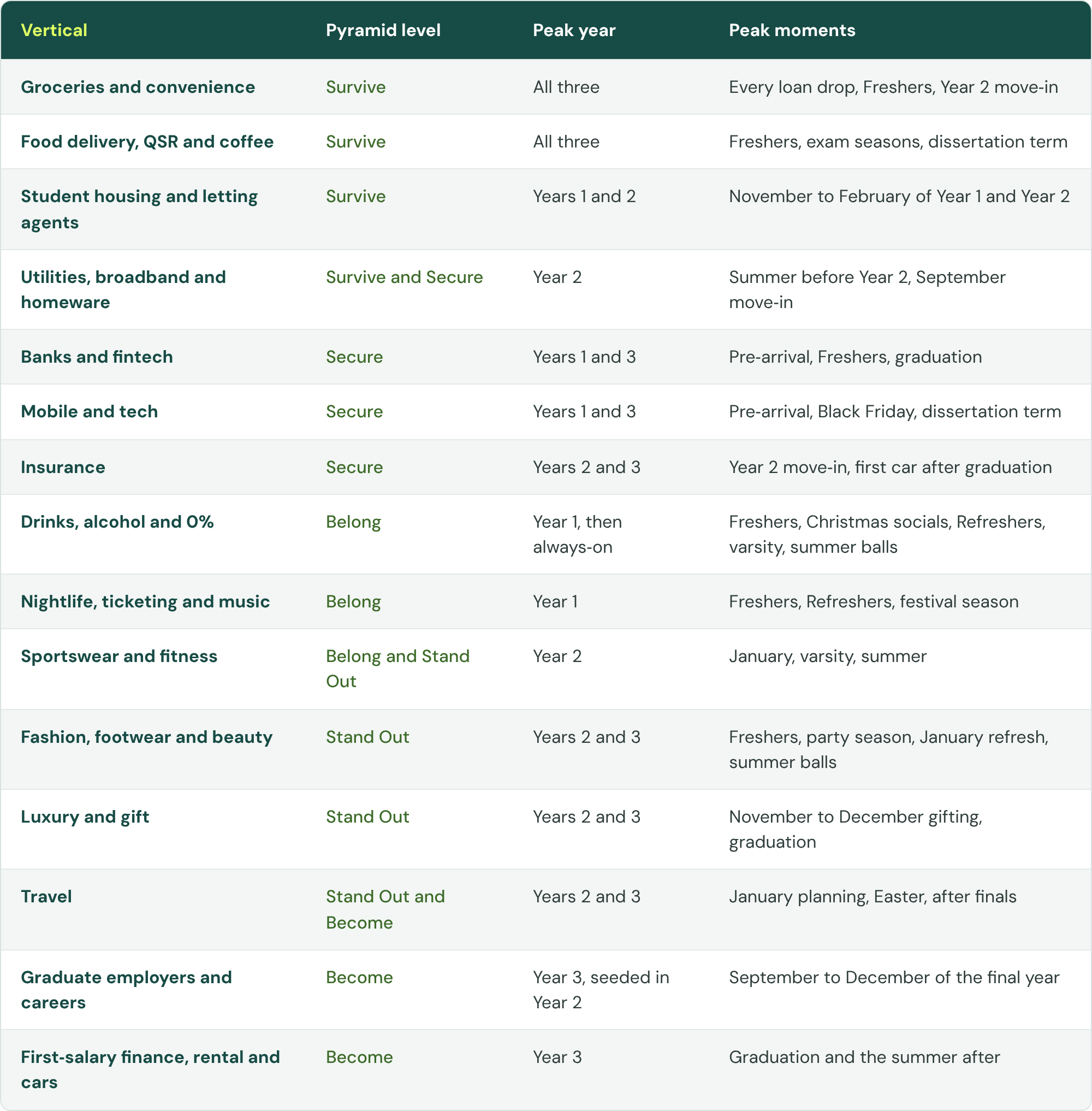
Quick reference: when each vertical should be on campus
Every category has a peak year and a peak moment. Most also have an always-on case, because the base of the pyramid refills every term.
The brands they take with them
A degree hands brands something no other audience offers: the same people, in the same buildings, on the same calendar, for three years, with their needs changing in a known order.
Students' Unions are where that happens. They gather a whole audience through a life transition, in one shared building, where students find their communities, explore their interests and celebrate what they achieve. Digital media can reach students on countless platforms. Campus media puts a brand in the room where student life actually unfolds.
But reach was never the point. Understanding what matters to students when you reach them is.
The 18-year-old who walks into the union in September is choosing a bank, a supermarket and a drink. The 21-year-old who walks out in July is choosing a career, a city and a salary to spend. Students aren't an audience that arrives every September and disappears in June. They are people in the middle of becoming.
Understand that change, and marketing can do more than reach them. It can grow with them.
It's time to stop asking how brands win Freshers in isolation, and start asking how they earn a place in the three years that follow.
Sources:
- HESA, Higher Education Student Statistics: UK, 2024/25: 2.86 million students, 668,170 first-degree entrants
- HESA term-time accommodation, via StuRents (June 2026): four in five live away from home
- Student Finance England: maintenance loans paid in September, January and April
- Pion: 65% stay loyal to brands discovered during Freshers
- Eighteen24 proprietary research: 78% more open to new brands in September, 70% try new brands at transition moments, £2.2bn term-one spend
- University of Sussex, Refreshers 2026 and Aberystwyth SU housing survey: Refreshers timing and house-hunting spread
- NatWest Student Living Index 2025: £123 a month on clothes, shoes and accessories
- The Gym Group, Gen Z Fitness Pulse 2025: 73% of Gen Z exercise at least twice a week
- AtkinsRéalis careers advice: start researching graduate routes in second year
- Queen Mary University of London careers (2026): graduate schemes usually recruit September to December
- ISE Student Recruitment Survey 2025, via University of St Andrews Careers: 140 applications per graduate vacancy
- Institute for Fiscal Studies: £100,000 to £130,000 net lifetime graduate premium
- Universities UK analysis of DfE LEO data: 72% earnings growth from 23 to 31
- Yugo survey of 1,500 graduates: 85% still friends with university friends five years on
- Dawes, Ehrenberg-Bass Institute, Journal of Consumer Behaviour (2023): share of category requirements in spirits vs grocery
- UCAS Media and NUS research: 40+ minute average SU dwell time
- HEPI and Advance HE, Student Academic Experience Survey 2026: 66% happy with their course and institution, 45% rate value for money good or very good
- Savanta, What students are telling us about university life in 2026: 65% of full-time undergraduates work during term time, nearly 14 hours a week